We are proud to be a safe surgery
We are proud to be a safe surgery for everyone in our community, and pledge to endusre that everyone in our community receives the quality healthcare they are entitled to.
As a safe surgery we are committed to have taken steps to tackle the barriers faced by many migrants in accessing healthcare.
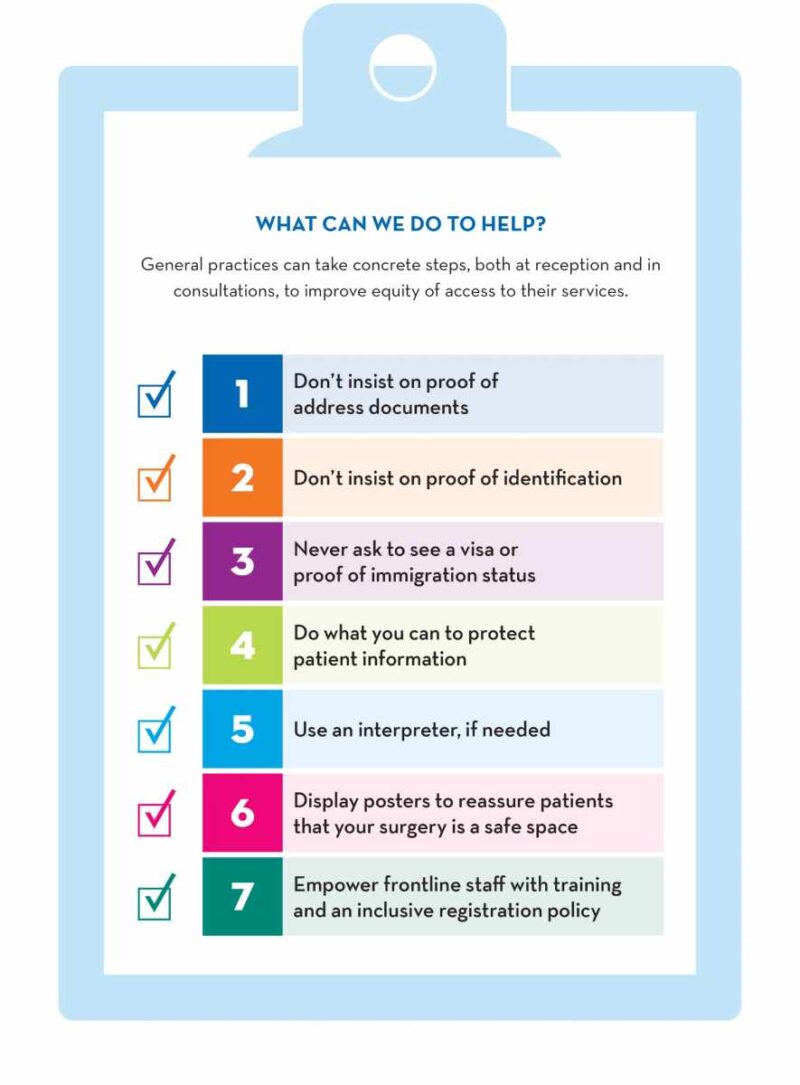
As a Safe Surgery we recognised and removed barrier to healthcare, particularly for migrants in vulnearable circumstances but also local citizens that may not be able to give us proof of address or ID
WHAT WE DO TO HELP?
What if a patient needs a referral to secondary care?
In England, some migrants, including refused asylum seekers and undocumented migrants, will be charged for secondary care (hospital or community services). While it’s important that GPs make referrals on clinical grounds alone, it can be helpful to understand charges they’re likely to face.
Refugees, asylum seekers and survivors of trafficking are entitled to free secondary care. So are survivors of torture, female genital mutilation, and domestic or sexual violence, if their treatment relates to their experience of violence.
Some services are free for everyone, including treatment given in A&E, diagnosis and treatment of specific infectious diseases, and contraception.
All urgent and immediately necessary treatment must be provided even if a patient can’t pay; it will be billed for later.
Maternity care is always considered immediately necessary.
The charging rules are complex; for more information, have a look at our resources below.
What if the Home Office contacts us for information about a patient?
If someone working for the Home Office contacts us for details about a patient, we ensure that no information is given without first discussing it with the patient’s GP.
General practices are under no legal obligation to provide information to the Home Office, unless there is a court order, a public health risk or it is in relation to a serious crime (murder, manslaughter or rape).
Immigration offences are not considered serious crime.
Consideration of any request should be informed by the GMC confidentiality guidance
What if we worry a patient isn’t getting the care they need?
For more information on how to support individual patients, contact DoTW UK on:
020 70789629
or
clinic@doctorsoftheworld.org.uk
Doctors of the world run a drop-in clinic and advice line for people who are having difficulty accessing the healthcare they need.
Key guidance
NHS England Standard Operating Principles on GP Registration (from page 144) 2017.
Available at: https://tinyurl.com/GPRegNHSE
CQC guidance on refugees, asylum seekers and vulnerable migrants
Available at: https://tinyurl.com/GPRegCQC
BMA guidance on registration of overseas visitors 2018
Available at: https://tinyurl.com/GPRegBMA
This resource was developed by Doctors of the World staff and volunteers (including doctors and nurses). By design, Safe Surgeries works with primary care to improve the quality of services for vulnerable groups.
Rights-based resources
Healthcare access guide for people seeking asylum. Equality and Human Rights Commission. 2019
Case studies: facilitating access to healthcare for people seeking and refused asylum. Equality and Human Rights Commission. 2019
DoTW UK
Go to www.doctorsoftheworld.org.uk for the following reports:
- Healthcare entitlement in England 2018
- Closing the Gaps in Healthcare Access: United Kingdom 2017
- Registration Refused: A study on access to GP registration in England Yearly since 2015